Parallel Connection
The device is connected in parallel with the existing brake-resistor circuit. It does not modify the lift's original control logic or safety circuits.
Capture and reuse braking energy with 20%–50% proven savings. A non-invasive, parallel-connected retrofit that requires just 15–30 minutes of downtime per lift.
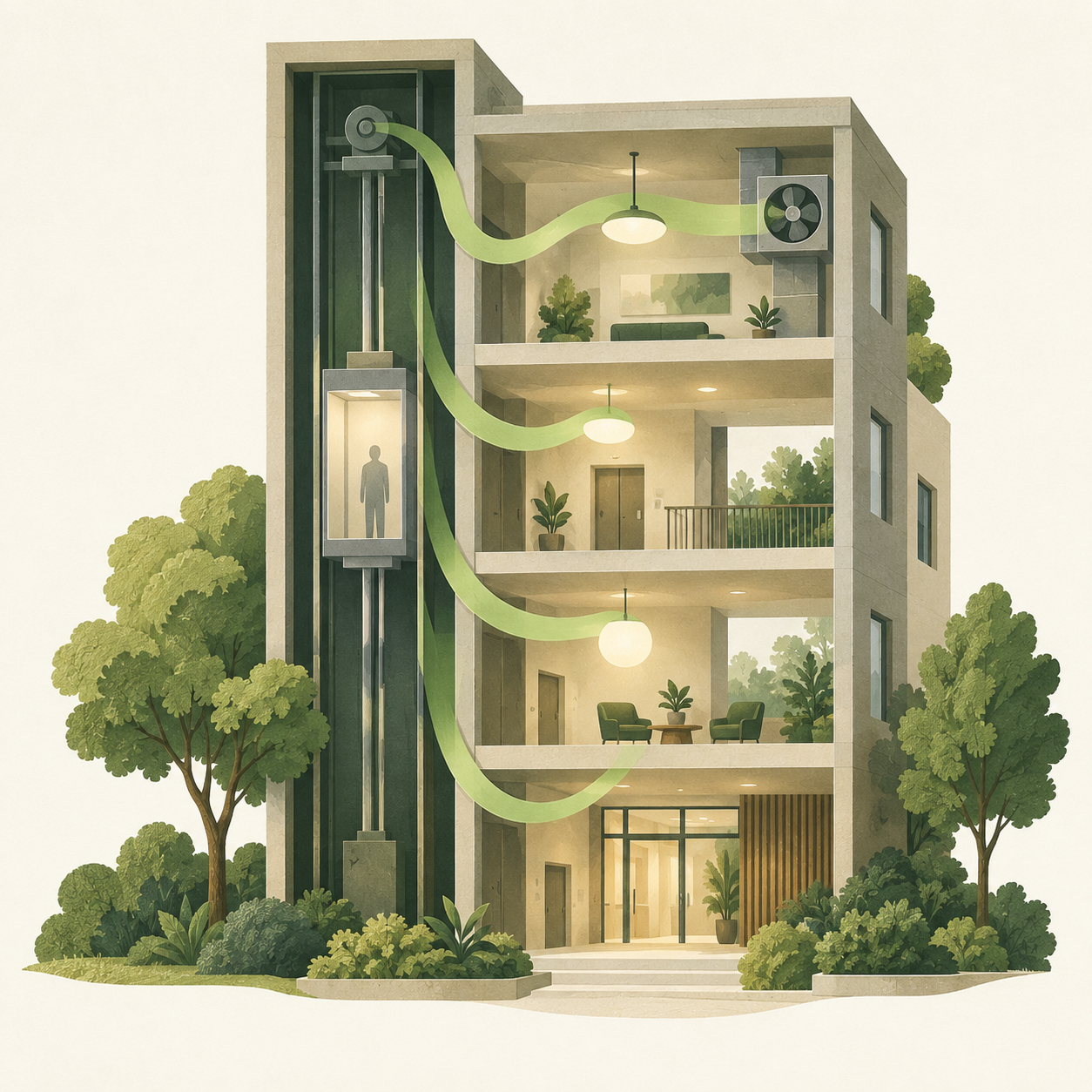
A lift motor acts as a generator whenever the car moves against the counterweight — travelling down with a heavy load, or up with a light one. In most existing lifts, this energy is routed to a brake resistor and released as heat inside the machine room.
EERS captures that energy, filters it, and feeds it back into the building's power supply, where it is consumed immediately by lighting, fans and other common-area loads.
Because the energy is no longer dissipated as heat, machine-room temperatures fall. In a tropical climate this matters: machine-room heat accelerates component ageing across a lift's 20–30 year service life, and lower temperatures reduce that thermal stress.
The device is connected in parallel with the existing brake-resistor circuit. It does not modify the lift's original control logic or safety circuits.
If the device develops any fault, the lift reverts automatically to its original brake-resistor mode and continues to operate normally.
Validated on lift brands commonly found in Asia, including Hitachi, Fujitec, KONE, Mitsubishi, Otis, Schindler, Yungtay and Canny.
The device requires no scheduled servicing and adds nothing to the lift's existing maintenance routine.
15–30 minutes per lift, with no extended downtime for residents or tenants. Electrical connection is carried out by a Licensed Electrical Worker in Singapore.
For clients who want to verify performance, we offer an optional 4G smart meter package that records regenerated energy independently of the lift's own systems. Under the shared savings model it is included as standard, since metered data forms the basis for settlement.
Building owners and managers can view real-time and historical data through an online dashboard, and receive regular savings reports suitable for management updates. An English interface is provided on deployment.
EERS has been deployed across numerous high-rise residential and commercial buildings, delivering consistent energy recovery.
Energy regeneration for lifts is offered in several forms. These are the points worth checking, whichever supplier you speak to.
| What to check | Our system | What to watch for elsewhere |
|---|---|---|
| Safety & approvals | Parallel connection; no modification to control or safety circuits | Solutions that modify lift circuits can trigger additional inspection and approval requirements |
| Energy storage | Capacitor-based, no batteries | Battery-based systems carry ageing and thermal-runaway risk in hot machine rooms |
| Power quality | Industrial DSP and PWM control, THD below 5% | Higher harmonic distortion can interfere with lift control electronics |
| Heat output | Low internal loss, minimal effect on machine-room temperature | Devices with high internal loss add to the machine room's heat load |
| Maintenance | No scheduled servicing; existing lift maintenance routine unchanged | Some systems add servicing requirements and coordination |
| Verification | Independent metering; savings traceable | Without separate metering, savings are difficult to substantiate |
| Scaling | Supports multi-lift and parallel deployment | Fixed configurations limit estate-wide rollout |
Built to international industrial standards, ensuring long-term reliability and peace of mind for building management.
A seamless, end-to-end partnership designed for property teams—from initial feasibility to ongoing peace of mind.
Test it risk-free for 3 months. Curious about your building's energy-saving potential? Share a few basic details about your lifts, and let's discuss a no-obligation trial tailored for your property.